

Safety Communication Design Capability Program.
Building an internal capability to design safety communications that cut through, are understood quickly, and prompt the right action in the real conditions people work in.
→ ACTED ON
Effective safety communication is not simply a matter of clearer messages.
Australia Post operates in a complex, high-volume environment where safety messages must compete with operational demands, local priorities and information overload. In this context, cutting through requires a deliberate capability to design communications that are understood quickly and prompt the right action in the real conditions people work in.
Opposite proposes a practical capability-building engagement that helps Australia Post strengthen this communication design capability from within. Rather than delivering generic communication skills training, the program helps safety leaders understand their communication ecosystem, apply behavioural and human-centred design principles to live safety challenges, and leave with tools, prototypes and ways of working that are sustainable beyond the project itself.
One of Australia's largest and most geographically dispersed workforces.
Communicating critical safety information consistently and effectively across this environment presents a unique challenge. Safety communications must compete with operational priorities, organisational messages, local issues and day-to-day demands on workers' attention. Whether communicating incidents, lessons learned, emerging risks, procedural changes or safety initiatives, there is a need to ensure that the most important messages cut through, are understood and lead to clear action.
As communication technologies continue to evolve, organisations also have access to an increasing range of tools and platforms. However, the effectiveness of these tools depends on understanding the psychology of communication, the needs of different audiences and the practical realities of how information is consumed within operational environments.
This project supports Australia Post's safety leaders to strengthen their capability to design and deliver effective safety communications, and to leave participants with practical examples, tools and approaches that can be applied within Australia Post's existing environment well beyond the project.
The opportunity is to build an internal capability to design communications that work.
Australia Post is seeking more than better-written safety messages. In our experience, safety communications often underperform not because the content is wrong, but because the design does not account for how people actually receive information.
How attention is won and lost in busy operational environments.
How different audiences interpret risk and relevance.
How messages are consumed across different channels and devices.
Where governance, approval pathways and tool limitations slow effectiveness.
How communications connect to actual decisions and behaviours on the ground.
How methods can be tested on live opportunities, then reused internally.
A four-stage engagement, from ecosystem review to sustainable practice.
Discovery & Communication Ecosystem Review
We establish a practical picture of how safety communication currently works across Australia Post: what gets sent, through which channels, by whom, with what approvals, and with what constraints. This includes a desktop review of channels, technologies, governance and workflows, the opportunities and constraints of AI and modern tools, and twelve stakeholder interviews of forty-five minutes each.
Capability Development Workshops
This stage develops a shared set of practical design principles and methods that participants can use to improve how safety information is shaped, prioritised and deployed. The workshops are hands-on and anchored in Australia Post examples, rather than abstract instruction. Three workshops are detailed below.
Pilot Communication Projects
Capability becomes useful when it is applied to real work. Alongside the workshops, Opposite works with two to three nominated communication champions on live safety communication opportunities, developing communications using the framework through iterative review and refinement. This stage turns theory into operational practice, while generating examples that can be reused internally.
Embedding & Sustainability
The final stage consolidates what has been learned and translates it into a practical operating model that can continue after the engagement. It focuses on refining reusable tools and templates, clarifying design principles and decision guides, identifying governance improvements, supporting internal champions, and creating a practical pathway for continued uptake. The goal is to leave Australia Post with a stronger internal capability, not dependency on external support.
Designing Communications that Cut Through
- Psychology of attention
- The Signal Model
- Visual communication principles
- Behavioural design principles
- Common communication failures
- Practical examples
Making Messages Matter
- Storytelling for safety communications
- Message hierarchy
- Drafting content that drives action
- AI and modern communication tools
- PowerPoint, ChatGPT and content tools
- Practical design exercises
Embedding & Sustaining Effective Communications
- Communication deployment
- Stakeholder engagement
- Reinforcement strategies
- Measuring effectiveness
- Governance and sustainability
Three ways to engage, scaled to ambition and budget.
Communication Design Masterclass
- Desktop review
- 8 stakeholder interviews
- Communication ecosystem review
- Workshop 1
- Workshop 2
Communication Design Capability Program
- Desktop review
- 12 stakeholder interviews
- Communication ecosystem mapping
- Three workshops
- Pilot communication project
- Communication toolkit
Strategic Communication System
- Everything in Option B
- Communication templates
- Communication design standards
- Communication playbook
- AI-enabled workflow guidance
- Leadership briefing & handover
Pricing basis: indicative investment calculated at Opposite's standard consulting rate of $2,200 per day, and a design and build rate of $1,500 per day (ex. GST).
Interactive Safety Onboarding Module
An engaging onboarding experience introducing Australia Post workers and contractors to key safety expectations, critical risks and controls, safety communication principles, reporting pathways, and organisational values. The intent is a practical, well-designed experience that is easy to access, easy to understand and aligned with Australia Post's operational reality.
What this could look like in practice.
A recent onboarding module built in this format walks a contractor through a single shift. It mirrors their delivery style across five quick moments, tests them against eight real risks with graded feedback, connects each call to the four values, and ends with a personalised dashboard they keep. The four screens below are drawn directly from that build.
The same format adapts to Australia Post's own risks, roles and values. It runs in any browser on a phone or desktop, needs no login, and can be deployed as a standalone web experience or packaged for an LMS.
| Component | Detail | Days |
|---|---|---|
| Desktop review | Existing onboarding, communications, policies, training content | 1 |
| Co-design workshop | Learning objectives, user needs, technical requirements, success measures | 1 |
| Design & development | Three review cycles: journey & wireframes, working prototype, final revisions & testing | 7 |
| Stakeholder engagement | Reviews, testing, coordination with IT and Corporate Communications | 2 |
| Visual design | AI-generated imagery | 1 |
| Base investment | $20,800 ex. GST | 12 |
| Upgrade | Description | Additional |
|---|---|---|
| Web-based experience | Responsive, desktop and mobile, no LMS required | Included |
| LMS / Captivate deployment | LMS packaging, Captivate development, integration, completion tracking | +5 days · +$11,000 |
| Hybrid illustration approach | 2 to 3 additional days | $3,000 to $4,500 |
| Custom illustration package | 5 days at $1,500 per day | $7,500 |
A team that works where the system meets the human.

Dr Nicholas Duck
Head of Opposite and an Organisational Psychologist with deep experience helping organisations make complex, often safety-critical systems easier and safer for people to use. He leads multidisciplinary projects spanning safety, communication, capability and system design, with a facilitation style that is practical, engaging and grounded in the realities of frontline work.

Rahnuma Tasneem
Supports the design and delivery of the program, with a focus on human-centred communication design, workshop development and practical application. She will contribute to all custom design artefacts, prototype development and toolkit development, ensuring outputs are clear, usable and designed for adoption within Australia Post's operating context.

Tim Farley
A Registered Psychologist and Safety and Capability Specialist with experience across infrastructure, property, health and other high-risk environments. His work focuses on critical risk, psychosocial hazards and the design of practical safety systems for frontline settings, translating complex requirements into clear, usable tools and guidance.
Clarity at scale, across dispersed and operationally busy teams.
Compass Group
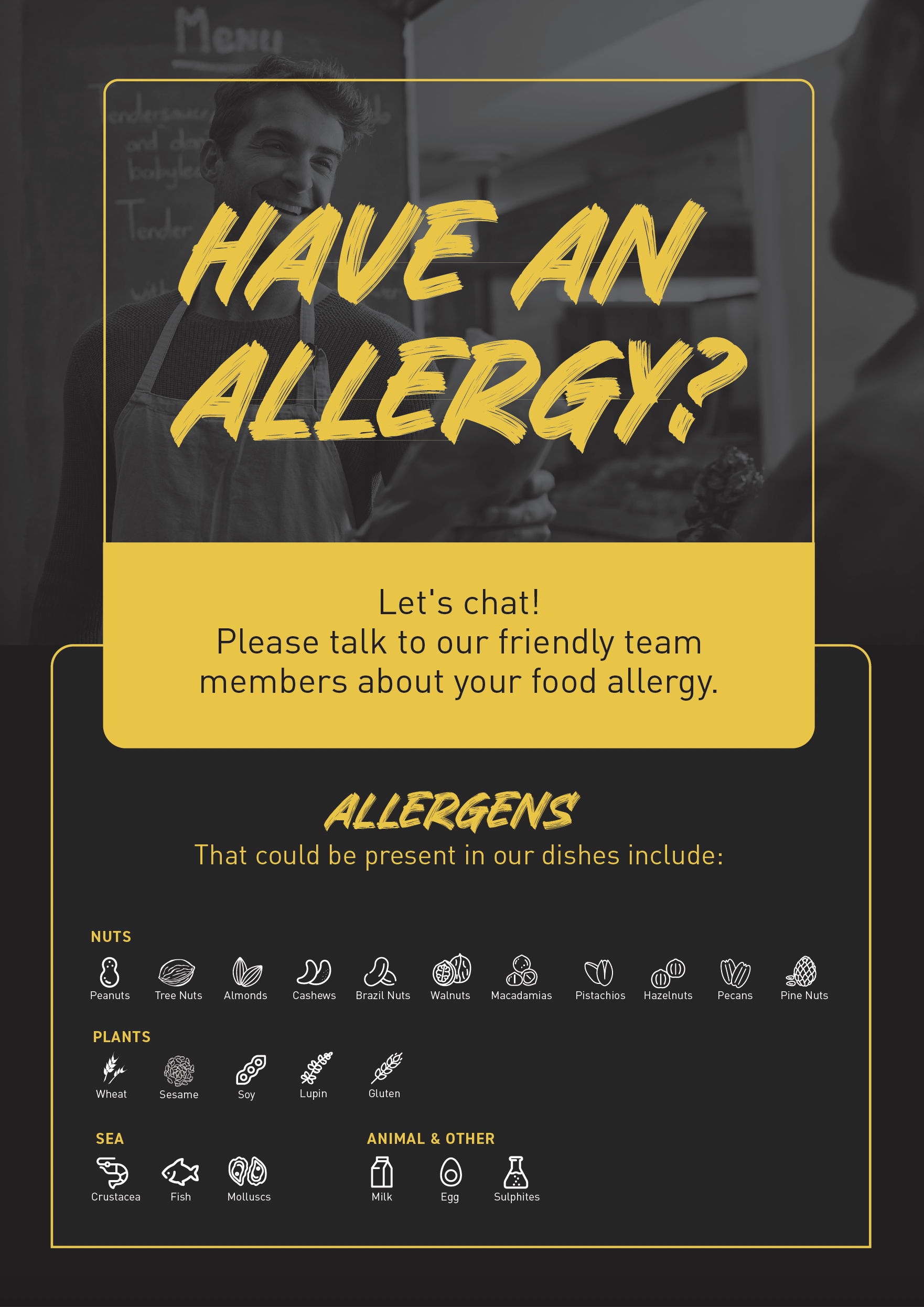
Compass Group engaged Opposite to help improve how key allergy prevention controls were communicated and applied across their large-scale food production sites, including universities, mining camps, and retail venues.
We quickly discovered the sheer complexity of managing allergens in these environments. With the number of known allergens on the rise, and the risks of getting it wrong being severe, it was clear the existing systems needed a human-centred rethink.
We reviewed current controls through a behavioural lens and identified where errors were likely to creep in. Then we redesigned the tools: clearer posters, practical checklists, and simple visual cues that made it easier for staff to understand what they were dealing with and what to do, especially under pressure.
We also developed more intuitive labelling systems and storage zone markers to improve separation and reduce cross-contamination risks at the source.
- Improved staff understanding and consistency of allergy control practices
- Enhanced food storage labelling concepts for safer allergen separation
Woolworths Group
Woolworths Group is not one business. It is a family of businesses, from supermarkets to distribution centres to drinks and retail, each with different operations, different risks and different ways of working. Opposite has supported Woolworths to translate group-wide safety standards into action across this range of businesses, in a way that holds a single standard while respecting how each business actually runs.
The work spans both ends of the system. At the back end, we shaped the safety standard itself into something clear and navigable, structured around its foundations, who is accountable for what, and the assessable requirements each business unit works through and adapts to its own context. At the front end, we designed the practical tools that turn that standard into everyday behaviour on the floor and in the cab.
The consistent theme has been translating complex requirements into simple, practical experiences that fit within day-to-day operations. Rather than producing artefacts in isolation, the approach designs for use, adoption and sustained improvement across systems, teams and workflows.
- Backend standard restructured into clear foundations, roles and assessable requirements
- Frontline tools that turn the standard into action for each business unit
- A progress view that shows where each business is up to, section by section
Group
Communication & Consultation
An eight-week shape for the recommended Option B.
The timeline can be adjusted to align with Australia Post availability, stakeholder access and internal governance timeframes.
| Option | Indicative duration |
|---|---|
| Option A | 3 to 4 weeks |
| Option B Recommended | 7 to 8 weeks |
| Option C | 8 to 10 weeks |
| Optional onboarding add-on | 5 to 7 weeks |
Program investment summary.
| Option | Days | Price (ex. GST) | Key deliverables |
|---|---|---|---|
| A · Communication Design Masterclass | 12 | $24,300 | Desktop review, 8 interviews, ecosystem review, Workshops 1 to 2 |
| B · Capability Program Recommended | 17 | $35,300 | Discovery, 12 interviews, ecosystem map, 3 workshops, pilot project, toolkit |
| C · Strategic Communication System | 23 | $47,800 | Option B plus templates, standards, playbook, AI workflow guidance, leadership handover |
| Add-on · Interactive Safety Onboarding (base) | 12 | $20,800 | Discovery, co-design, prototype, stakeholder engagement, AI imagery |
| Add-on upgrade · LMS / Captivate | +5 | +$11,000 | LMS packaging, integration support, completion tracking |
All fees are exclusive of GST. Travel and out-of-pocket expenses, if required, would be agreed in advance and charged separately.
Assumptions
- Workshops are delivered remotely unless otherwise agreed
- Stakeholder interviews are coordinated by Australia Post
- Relevant materials and access to current artefacts are provided in a timely manner
- Pilot communication opportunities are nominated early in the project
- One consolidated review process is used for major deliverables
- Effort assumes reasonably efficient access to stakeholders and reviewers
Exclusions
- Full production rollout of communications beyond the pilot prototypes
- Enterprise-wide technology implementation
- LMS configuration beyond the optional onboarding module scope
- Translation services
- Large-scale visual asset production beyond the stated scope
- Ongoing measurement after project close
- Travel and accommodation costs
We approach safety communication as a system design challenge.
Opposite brings together organisational psychology, behavioural insight, human factors and practical design. We do not approach safety communication as a content problem alone. Attention, behaviour, workflow, channel, governance and usability all matter.
That is why our focus is not on delivering a set of workshops and walking away. It is on helping Australia Post build a practical, sustainable communication design capability that improves the quality, consistency and impact of safety communication over time.